How the sentence case rules work
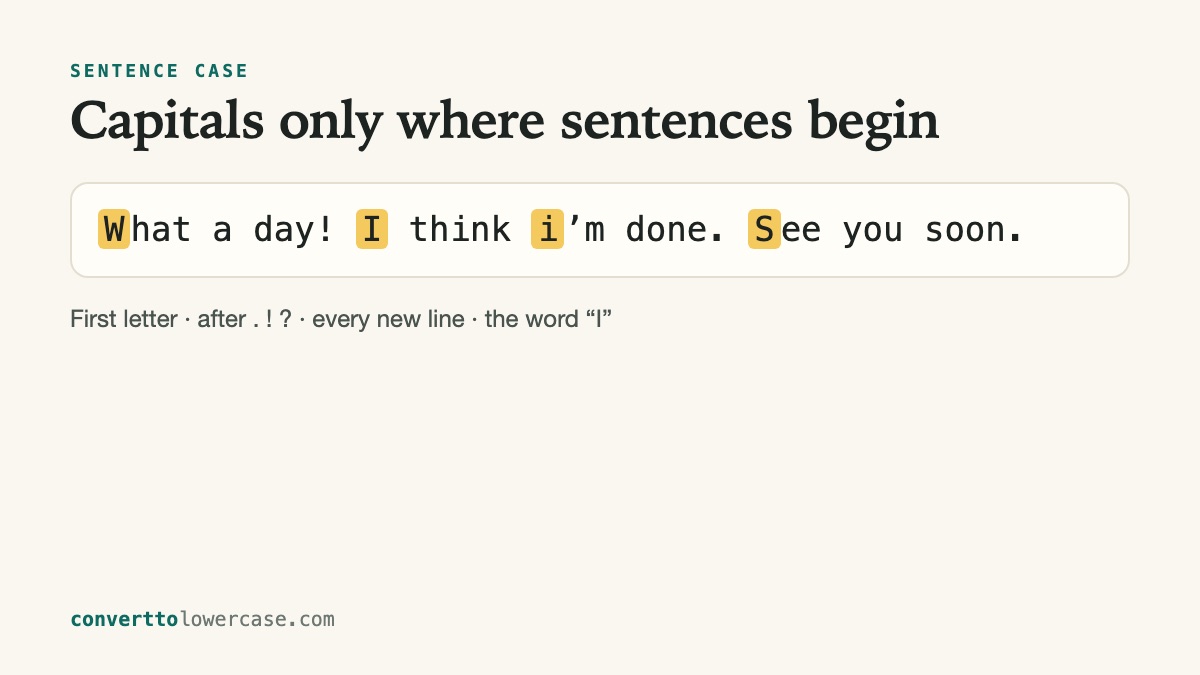
This converter follows the rules most people expect from ordinary writing:
- All letters are made lowercase first.
- The first letter of the text is capitalised.
- A letter that follows a full stop, question mark, exclamation mark or ellipsis and a space is capitalised. Closing quotes and brackets after the punctuation are allowed.
- The first letter of every new line is capitalised, which suits lists and subtitles.
- The English pronoun “I” is capitalised on its own and in contractions like “I’m”, “I’ll” and “I’ve”.
Names, places and brands cannot be detected automatically. Add them to Options → Always keep these words and they keep their capitals.
Sentence case vs Title Case
Sentence case capitalises only the first word (and proper nouns); Title Case capitalises every important word. Many modern style guides — including those used by government websites and most app interfaces — now prefer sentence case for headings because it reads more naturally.
| Sentence case | Title Case |
|---|---|
How to plan a weekend in Lisbon | How to Plan a Weekend in Lisbon |
Settings and privacy | Settings and Privacy |
Where sentence case is used
- Body text, captions and e-mail subject lines.
- Buttons, menus and error messages in apps and websites.
- Headings in documentation, news sites and many academic reference lists.
Frequently asked questions
What is sentence case?
Sentence case is the way you normally write a sentence: the first word starts with a capital letter, proper nouns are capitalised, and everything else is lowercase.
Does it handle abbreviations like “e.g.” correctly?
A full stop followed by a space starts a new sentence, so a word after “e.g.” may be capitalised. Check abbreviations before copying, or rephrase them.
Why is “i” changed to “I”?
In English the pronoun “I” is always capitalised. The rule only applies to the standalone word, not to letters inside other words, and it is skipped when a Turkish or Azerbaijani language option is selected.